Saturday, October 5, 2013
Wednesday, April 10, 2013
Earthquake in Bushehr, Iran: Reach out + Help out / هموطنان عزیز بابت زلزله بوشهر تسلیت عرض می کنیم.
زلزله ای به مقدار 6.1 ریشتر روز سه شنبه 20 ام فروردین ماه در ساعت 16:22 بوشهر و شهر های اطراف را لرزاند. در این زلزله 37 نفر کشته و 850 نفر مجروح شدند. / An earthquake occurred in Bushehr province of Iran, in 9 Apr. 2013. 37 people killed and 850 people are injured yet.
Wednesday, March 27, 2013
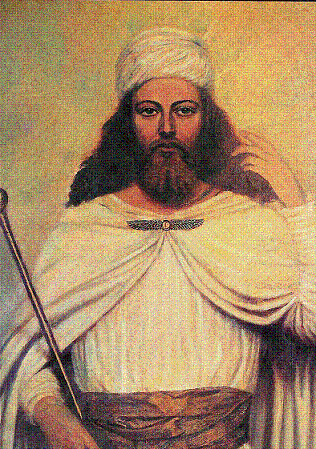
زادروز زرتشت پیامبر فرخنده باد / 27th of March, Birthday of Zoroaster
زَرتُشت یا زَردُشت پیامبر ایران باستان بود که مزدیسنا را بنیان گذاشت.
وی همچنین سراینده گاتها، کهنترین بخش اوستا میباشد. زمان و محل دقیق تولد وی مشخص نیست اما گمانهزنیها و اسناد، زمانی بین ۶۰۰۰ تا ۶۰۰ سال پیش از میلاد مسیح را برای او حدس زدهاند و زادگاه وی را به مناطق مختلفی مانند ری، آذربایجان، خوارزم و سیستان نسبت دادهاند. تعلمیات زرتشت بعدها با باورهای بومی ایرانیان ترکیب شد و آئین مزدیسنای کنونی که نزدیک به پنج سده دین رسمی ایران نیز بودهاست، را پدید آورد. نام زرتشت در فهرست یکصد نفرهٔ انسانهای تاثیرگذار تاریخ که توسط مایکل هارت تنظیم شدهاست، قرار دارد. دین زرتشت امروزه حدود ۲۰۰ هزار تن پیرو در ایران، هند و برخی نقاط دیگر جهان دارد.جامعهٔ زرتشتیان ایران زادروز زرتشت را روز خرداد از ماه فروردین برابر با ۶ فروردین و در سال ۱۷۶۸ پیش از میلاد و تاریخ درگذشت او ۵ دی ۱۶۹۱ پیش از میلاد تعیین کردهاست. اما این باور که به تازگی متدوال شده و زرتشتیان هند آنرا به رسمیت نمیشناسند، فاقد منبع تاریخی است.
/ Zoroaster (/ˌzɒroʊˈæstər/ or /ˈzɒroʊˌæstər/), also known as Zarathustra (/ˌzɑrəˈθuːstrə/; Avestan: Zaraϑuštra), was the prophet and founder of Zoroastrianism (By many sources believed to be the world's first monotheistic religion)[citation needed]. Though he is often mentioned as a Persian, his birthplace is uncertain. It is now widely thought that he was born in the eastern part of the Iranian Plateau. He is credited with the authorship of the Yasna Haptanghaiti as well as the Gathas, hymns which are at the liturgical core of Zoroastrianism. Most of his life is known through the Zoroastrian texts. The language spoken by Zoroaster, Old Avestan, used for composing the Yasna Haptanghaiti and the Gathas, on archaeological and linguistic grounds, is dated to have been spoken probably in the first half of the 2nd millennium BCE
زَرتُشت یا زَردُشت پیامبر ایران باستان بود که مزدیسنا را بنیان گذاشت.
وی همچنین سراینده گاتها، کهنترین بخش اوستا میباشد. زمان و محل دقیق تولد وی مشخص نیست اما گمانهزنیها و اسناد، زمانی بین ۶۰۰۰ تا ۶۰۰ سال پیش از میلاد مسیح را برای او حدس زدهاند و زادگاه وی را به مناطق مختلفی مانند ری، آذربایجان، خوارزم و سیستان نسبت دادهاند. تعلمیات زرتشت بعدها با باورهای بومی ایرانیان ترکیب شد و آئین مزدیسنای کنونی که نزدیک به پنج سده دین رسمی ایران نیز بودهاست، را پدید آورد. نام زرتشت در فهرست یکصد نفرهٔ انسانهای تاثیرگذار تاریخ که توسط مایکل هارت تنظیم شدهاست، قرار دارد. دین زرتشت امروزه حدود ۲۰۰ هزار تن پیرو در ایران، هند و برخی نقاط دیگر جهان دارد.جامعهٔ زرتشتیان ایران زادروز زرتشت را روز خرداد از ماه فروردین برابر با ۶ فروردین و در سال ۱۷۶۸ پیش از میلاد و تاریخ درگذشت او ۵ دی ۱۶۹۱ پیش از میلاد تعیین کردهاست. اما این باور که به تازگی متدوال شده و زرتشتیان هند آنرا به رسمیت نمیشناسند، فاقد منبع تاریخی است.
/ Zoroaster (/ˌzɒroʊˈæstər/ or /ˈzɒroʊˌæstər/), also known as Zarathustra (/ˌzɑrəˈθuːstrə/; Avestan: Zaraϑuštra), was the prophet and founder of Zoroastrianism (By many sources believed to be the world's first monotheistic religion)[citation needed]. Though he is often mentioned as a Persian, his birthplace is uncertain. It is now widely thought that he was born in the eastern part of the Iranian Plateau. He is credited with the authorship of the Yasna Haptanghaiti as well as the Gathas, hymns which are at the liturgical core of Zoroastrianism. Most of his life is known through the Zoroastrian texts. The language spoken by Zoroaster, Old Avestan, used for composing the Yasna Haptanghaiti and the Gathas, on archaeological and linguistic grounds, is dated to have been spoken probably in the first half of the 2nd millennium BCE
Wednesday, March 20, 2013
Happy new Persian year "Norouz" / نوروز باستانی و سال 1392 خورشیدی مبارک باد
- Nowrūz , IPA: [nouˈɾuːz], meaning "[The] New Day") is the name of the Iranian/Persian New Year in Iranian calendars and the corresponding traditional celebrations. Nowruz is also widely referred to as the "Persian New Year".Nowruz is celebrated and observed by Iranian peoples and the related cultural continent and has spread in many other parts of the world, including parts of Central Asia, Caucasus, South Asia, Northwestern China, the Crimea and some groups in the Balkans.Nowruz marks the first day of spring and the beginning of the year in the Iranian calendar. It is celebrated on the day of the astronomical Northward equinox, which usually occurs on March 21 or the previous/following day depending on where it is observed. As well as being a Zoroastrian holiday and having significance amongst the Zoroastrian ancestors of modern Iranians, it is also celebrated in parts of the South Asian sub-continent as the new year. The moment the Sun crosses the celestial equator and equalizes night and day is calculated exactly every year andIranian families gather together to observe the rituals.The term Nowruz in writing first appeared in Persian records in the 2nd century AD, but it was also an important day during the time of the Achaemenids c. 548–330 BC), where kings from different nations under the Persian empire used to bring gifts to the Emperor, also called King of Kings (Shahanshah), of Persia on Nowruz. The significance of Nowruz in the Achaemenid empire was such that the great Persian king Cambyses II's appointment as the king of Babylon was legitimized only after his participation in the New Year festival (Nowruz).The UN's General Assembly in 2010 recognized the International Day of Nowruz, describing it a spring festival of Persian origin which has been celebrated for over 3,000 years.During the meeting of The Inter-governmental Committee for the Safeguarding of the Intangible Heritage of the United Nations, held between 28 September – 2 October 2009 in Abu Dhabi, Nowrūz was officially registered on the UNESCO List of the Intangible Cultural Heritage of Humanity. /نوروز برابر با یکم فروردین ماه (روزشمار خورشیدی)، جشن آغاز سال و یکی از کهنترین جشنهای به جا مانده از دوران باستان است. خاستگاه نوروز در ایران باستان است و هنوز مردم مناطق مختلف فلات ایران نوروز را جشن میگیرند. امروزه زمان برگزاری نوروز، در آغاز فصل بهار است. نوروز در ایران و افغانستان آغاز سال نو محسوب میشود و در برخی دیگر از کشورها تعطیل رسمی است.بنا به پیشنهاد جمهوری آذربایجان، مجمع عمومی سازمان ملل در نشست ۴ اسفند ۱۳۸۸ (۲۳ فوریه ۲۰۱۰) ۲۱ ماه مارس را بهعنوان روز جهانی عید نوروز، با ریشهٔ ایرانی بهرسمیت شناخت و آن را در تقویم خود جای داد. در متن به تصویب رسیده در مجمع عمومی سازمان ملل، نوروز، جشنی با ریشه ایرانی که قدمتی بیش از ۳ هزار سال دارد و امروزه بیش از ۳۰۰میلیون نفر آن را جشن میگیرند توصیف شدهاست.پیش از آن در تاریخ ۸ مهر ۱۳۸۸ خورشیدی، نوروز توسط سازمان علمی و فرهنگی سازمان ملل متحد، به عنوان میراث غیر ملموس جهانی، به ثبت جهانی رسیدهبود. در ۷ فروردین۱۳۸۹ نخستین دورهٔ جشن جهانی نوروز در تهران برگزار شد و این شهر به عنوان «دبیرخانهٔ نوروز» شناخته شد.
Monday, February 18, 2013
سپندارمذگان یا اسفندگان بر همه خجسته باد / Happy Sepandarmazegan (Esfandegan) to everyone
Sepandārmazgān (Persian: سپندارمذگان) is a Zoroastrian festival. This day was dedicated to Spənta Ārmaiti (Avestan for "Holy Devotion", Spandārmad in Middle Persian, Persian: سپندارمذ Spendārmad or Sepandarmaz), the Amesha Spenta who was given the domain of "earth". The date of the festival as observed in the Sassanid era was on the 5th day of the month Spandarmad, the Spandarmad. When the name of the day and the month of the day were the same, a "name-feast" celebration was always done.According to the testimony of al-Biruni, in the 11th century BC there was a festival when the names of the day and the month were the same. The deity Spandarmad protected the Earth and the "good, chaste and beneficent wife who loves her husband". According to him, the festival used to be dedicated to women, and men would make them "liberal presents", and the custom was still flourishing in some districts of Fahla.
jashan-e burzigarán (Festival of Agriculturists), is celebrated in Iran also in the 5th day of Spandarmad month (the Spandarmad day). People pray for good harvets, honor the deity of Earth Spandārmad, and put signs in doors to destroy evil spirits.
The observation of this festival has been revived in modern Iran, where it is mostly set on the 29th day of Bahman in the Solar Hejri calendar introduced in 1925, corresponding to 18 February. The modern festival is a celebration day of love towards mothers and wives. / جشن اسفندگان (سپندارمذگان) یا جشن مردگیران یکی از جشنهای ایرانی است که در روز ۵ اسفند برگزار میشود. ابوریحان بیرونی در آثارالباقیه آوردهاست که ایرانیان باستان روز پنجم اسفند را روز بزرگداشت زن و زمین میدانستند. اگرچه منابع کهن از جمله ابوریحان این جشن را در روز پنجم اسفند ذکر کردهاند. ولی با توجه به تغییر ساختار تقویم ایرانی در زمان خیام که پس از ابوریحان میزیست، و سی و یک روزه شدن شش ماه نخست سال در گاهشماری ایرانی، تاریخ ذکر شده در منابع کهن را باید به روز رسانی کرد. امروز بعضی زرتشتیان آنرا در روز اسفند (سپندارمذ - پنجمین روز) از ماه اسفند (سپندارمذ) برابر با بیست و نهم بهمن در گاهشماری خورشیدی امروزین برگزار میکنند. اما موبد کورش نیکنام برگزاری جشنها با استفاده از گاهشماریهای سنتی با ماههای ۳۰ روزه را بیتوجهی به دانش نجوم و دستاوردهای خیام و موجب ناهماهنگی در جشنها دانسته و لزوم توجه به گاهشماری ملی و رسمی با ماههای ۳۱ روزه را یادآور شده است.
Monday, December 31, 2012
کریسمس مبارک / We wish you a Merry Christmas and a happy new year / Ցանկանում ենք ձեզ Շնորհաւոր նոր տարի / 我們祝你聖誕快樂,新年快樂 / nous vous souhaitons un joyeux Noël et une bonne année / les deseamos una Feliz Navidad y feliz año nuevo / Wir wünschen Ihnen ein frohes Weihnachtsfest und ein glückliches neues Jahr / Мы желаем вам веселого Рождества и счастливого Нового года / σας ευχόμαστε Καλά Χριστούγεννα και ευτυχισμένο το νέο έτος / size bir Mutlu Noeller ve mutlu bir yeni yıl diliyorum / vi auguriamo un Buon Natale e felice anno nuovo / 우리는 당신에게 기쁜 성탄과 행복한 새해를 기원 / გისურვებთ შობა ახალი წელი / Vi önskar dig en God Jul och Gott nytt år / हम आपको एक मेरी क्रिसमस और नया साल मुबारक हो इच्छा / přejeme vám veselé Vánoce a šťastný nový rok / nais naming ka ng isang Maligayang Pasko at masaya bagong taon / אנו מאחלים לך חג מולד שמח ושנה טובה / toivotamme teille hyvää joulua ja onnellista uutta vuotta / życzymy Wesołych Świąt i Szczęśliwego nowego roku
Friday, August 31, 2012
Iranian Folk Music
Folk music
Ancient Iranians attached great importance to music and poetry, like today. Post Sassanid era silver plate. 7th century. The British Museum. Main article: Iranian folk music The modal concepts in Persian folk music are directly linked with that of the classical music. However, improvisation plays a minor role as folk tunes are characterized by relatively clear-cut melodic and rhythmic properties. The function of each folk melody determines its mood. The varying aesthetic requirements of wedding songs, lullabies, love songs, harvest songs, dance pieces, etc., are met with transparent and appropriate simplicity. The majority of the classical instruments are too elaborate and difficult for the folk musicians. Instead, there are literally dozens of musical instruments of various sorts found among the rural people. In fact, each region of the country can boast instruments peculiar to itself. Three types of instruments, however, are common to all parts of the country. They are, a kind of shawm called Surnay (or Sorna ~ Zorna), the various types of Ney (flute), and the Dohol, a doubleheader drum. Persian music includes a mixed Persian-Western music that functions as popular commercial music. The use of western popular rhythms, an elementary harmonic superimposition, and relatively large ensembles composed of mostly western instruments, characterize this music. The melodic and modal aspects of these compositions maintain basically Persian elements. On the whole, it would be something of an understatement to say that the artistic merit of such a melange as this is rather questionable.
Iran is home to several ethnic groups, including Kurds, Azerbaijanis, Bakhtiari and Baluchi peoples. Turkmen epic poets similar to Central Asian musicians are common in Khorasan, while Kurdish music is known for its double-reed duduk and an earthy, dance-oriented sound. The most famous personalities in Iranian folk music are Pari Zangeneh and Sima Bina.
Music of Azarbaijan (Azarbadegan,Iran ) This is the music of provinces of Zanjan, East Azerbaijan, West Azerbaijan and Ardabil in Iran . Azerbaijan like other parts of Iran has a distinct music. On February 21, 1828, under the Treaty of Turkmenchay, Russia seized the control of Iranian territory to the North of the River Aras, which is now called the Republic of Azerbaijan where they share very similar music as Azarbijanis in Iran . The number of Azerbaijnis in Iran is about three times larger than population of Republic of Azerbaijan. [edit]Kurdistan The forms of music found in various parts of Kurdistan, all known as Kurdish music, vary depending on the climate and geography of the regions as well as their contact with the neighboring cultures. For example, the melodies found among the people living in the mountains are different from those found among the people living in the meadows. However, the poetry and the rhythms are common to both areas. Kurdish music, similar to other Eastern music, is monophonic and modal (more specifically, based on the maqam system, which is loosely translated as modal). However, because multiple instruments with varying pitch range, color, and ornamentation capabilities are used to play the same melody, it is also heterophonic. In addition to` specifically Kurdish modes (maqams), Kurdish music also utilizes all the modes and dastgahs found in the traditional music of Iran. There are two forms of Kurdish music. The first is based on the maqam system. Similar to traditional music of Iran, improvisation plays an important role in Kurdish music. While a maqam is used to designate a certain melodic structure, a musician may improvise within this structure by employing variations on ornamental figures, rhythms, and melodic forms. The maqams of Kurdistan, preserved by oral tradition throughout generations, are based on microtonal tuning systems where one can find intervals of half step, full step, three quarter step, and one and a quarter step. [These intervals are not necessarily in an equal-tempered 24 tone scale.] The second form of Kurdish music is based on a set of melodies, known as gourani or closed, which have distinct and structured rhythms. The word gourani is derived from gabaran, which literally means "one who worships fire." This word is related to the ancient rituals of fire worship among the Zoroastrians. Through the passage of time gabaran was changed to gouran. Gourani is also the name of a tribe whose members speak Kurdish and are known for their poetry. The members of certain groups of dervishes (Ahle Hagh) in Kermanshah and certain regions of Sanandaj, use this word to refer to the songs performed during their spiritual ceremonies. Because of its distinct rhythm, gourani is often accompanied by other instruments, and in some cases by clapping. The poems used in most Kurdish music are filled with stories of romance and unrequited love. These poems have often two verses, which are divided in ten, eleven, or twelve syllables, and are based on the Gathas of the Zoroastrians. Kurdish melodies are very simple; their range is usually confined to a few notes. The form of the music is often strophic, and every gourani has a particular melody that is sung with various stanzas. At the end of every stanza the strophe is repeated unchanged throughout the song. Every gourani is characterized by a specific strophe. Similar to a lied or a chanson, gouranis may be accompanied by instrumental sections, which have three parts: prelude, middle section, and the ending. The prelude and the ending are performed by the group, and the middle section is performed in the form of call and response. Gouranis fall into several categories, each performed with specific melodies for specific occasions. Some examples are work gouranis, shepherd gouranis, romantic gouranis, religious and spiritual gouranis, festive gouranis, Chemari (mourning) gouranis, war gouranis, children gouranis, women gouranis, and Ramadan gouranis. Before Islam, the "religious and spiritual gouranis" were used by the Kurds in their worship rituals of Ahura Mazda (the wise and supreme god of Zoroastrianism), fire, the sun, and the moon. Within Islam, new gouranis were developed for worship of God and paying tribute to sacred figures. The dervish houre, Azan (special forms of reciting of the Koran), and zekr [also a ritualistic dance performed by the dervishes during devotional ceremonies] are among these types of gouranis. The "festive gouranis," which have strong and exciting rhythms, are used for marriage, circumcision, or holiday celebrations, and are often accompanied by dancing and clapping. The "war gouranis" have moving rhythms, and are often used with poems that induce feelings of nationalism and protection of freedom. "Children gouranis" have simple rhythms and accompany children's poems. "Women gouranis" are sung by women during their everyday chores, such as milking the cows, carrying water from the springs, or picking flowers. "Chemari gouranis," which are sung in the funerals while carrying the dead (especially a young deceased), are accompanied by sorna (a wind instrument) and dohol (a large percussion instrument), and have very sad poems. "Ramadan gouranis" are mostly used during the month of Ramadan to declare the coming of dawn [when people have food before fasting during the day]. Accompanied by sorna and dohol, they are played in elevated regions of cities and villages. (H. Kamkar - master musician www.kereshmeh.com) [edit]Khorasan Due to its ethnic diversity and the existence of different languages and religious observations (Sunni and Shi'a), the musical tradition of Khorasan is very rich. From the north to the south, the music scene varies greatly. In the north of Khorasan, one can find the bakhshi narrating and singing, among other things, "daastans" (stories in old Persian), although they can also sing in Kurdish about the historical deeds of local figures. They accompany themselves on the dotar. A leading exponent of this type is the late Haj Ghorban Soleimani. One can also find in the north, the Asheq who play "dohol" (double-faced drum), the "sorna" (a kind of oboe-like reed instrument) and the "qoshme" (double clarinet made of the central nervure of the plumage of birds tied together). The Asheq are specifically associated with the Kurds and play at wedding dances and village feasts. In the East of Khorasan, near Torbat Jam, the main instrument is the dotar with some modifications, but there are no Bakhshi and the music is different. Here, the music takes the form of "ghazal khani'" and is performed by singers of quatrains and "ghazals" - lyric poems based on the invocations of mystic poets like Rumi, Attar and Sheikh Ahmad Jami. Purely instrumental pieces also figure in the repertoire. More towards the south, in the regions of Birjand and Qa'in, the musical culture changes again: the dotar is no longer present (although it seems that in the past, it was played). The songs are called "sotak" and are accompanied on the "dayereh" (tambourine). (Ameneh Yousefzadeh - Musicologist) Turkmen Music In Golestan and Khorasan in Iran as in Turkmenistan and Uzbekistan, the word bakhshi means instrumentalist, singer, and storyteller. The word bakhshi comes from Turkish, and in turn from a Chinese word, po-shih, meaning erudite. Through the Turkish Ouigours, certain Chinese language elements infiltrated 13th and 14th century Mongol literature. The word bakhshi appeared in Turkmen, Iranian and Turkish literature with the advent of the Mongols. At the time, the role of the bakhshi seems to have been sometimes that of the healing shaman, and at other times that of a Buddhist priest. As for the bakhshi of Khorasan, they claim that the origin of their name can be found in the word bakhshande (donor, bestower of gifts) because of the musical gift that God has bestowed upon them. This is a title of respect in northern Khorasan and among the Turkmen of Torkaman-Sahra. The bakhshi can also be found in almost all of Central Asia, among the Kazakh, Kirghiz, Uzbek, and Turkmen people as well as in Afghanistan, Tajik-Arab and in Xinjiang. Among other ethnicities, on the other hand, the term bakhshi, throughout centuries has designated a bard, a story-teller, and singer of legends and epics. As a singer, the bakhshi is more precisely a narrator of dastan (story) and an instrumentalist who plays the dotar (long-necked two-stringed instrument) and who, in most cases, fabricates his own musical instrument. The majority of the great bards of Khorasan, regardless of their ethnic origin, sing in three languages (Turkish, Persian, and Kurdish). Whether professional or semi-professional, nowadays the bard doesn't usually earn his living solely through playing music. Most often, he is also, for example, a farmer, a barber, or a teacher. With his instrument, the dotar, he usually sings and plays by himself. However, the Turkmen bards prefer to play in groups of two or three. In this case, the bard is accompanied by another dotar player and a person playing the kamanche. The right to assume the title of bakhshi is subject to specific conditions. A bakhshi should not only be a good musician and have a good voice, he also needs excellent diction for telling stories. Ideally, he learns his art from his father or his uncle while living under the family roof. Some acquire their apprenticeship under the tutelage of a master (ostad). The learning process evolves in three stages: 1) learning the dotar technique, 2) learning vocal techniques, 3) memorizing the stories. In the last stage, the master teaches his student a fragment of a dastan on a daily basis, so that he can memorize and recite it the next day. The bakhshi is renowned for his prodigious memory. Traditionally, the bakhshi plays at village ceremonies such as weddings and circumcisions, but he also performs at private gatherings and in ghahve-khanes (coffee houses) of the bazars. Unfortunately, nowadays, television has taken the place of the traditional bard in the Ghahve-khane. Fortunately, today we can also hear the bakhshi performing in concerts often within the context of festivals (Ameneh Yousefzadeh). [edit]Mazandaran Mazandaran has a diverse folk music culture that includes songs and instrumental and ritual music. Rhythm is usually simple in songs, which include katuli, which is most common around the town of Aliabad-e Katul; the song is sometimes said to be sung when people take a catouli cow out to graze. Because the song was originally sung while walking and working, it often has syllables like jana, hey or aye added, to allow the singer to breath while working (a work song). Another kind of song is called kaleh haal (or kal kaal or Leili's lover). The term kaleh haal may refer to its shortness of length (kale haal means short present) or to its common wingers, housewives who sang it while cooking with a kaleh, a type of oven. Amiri songs usually use long poems written by Amir Pazevari, a legendary poet from Mazandaran. A type of song called najma describes the love between Prince Najmedin of the Fars area and a girl named Ranaa. The najma is popular throughout Iran, adapted for the local cultures. The Charvadars are an ancient class of merchants who sold commodities abroad for a local village; their songs are called charvadari. In contrast to most Mazandarani music, charvadari has a prominent rhythm, which may be because it was often sung on horseback. Traditional music of women This music is a special type of folk music. Maryam Akhondy, a classical singer, collected such songs and published them on her album "Banu - Songs of Persian Women". It had been sung at the cradle, at the housework and work in the fields or on women's celebrations.
Ancient Iranians attached great importance to music and poetry, like today. Post Sassanid era silver plate. 7th century. The British Museum. Main article: Iranian folk music The modal concepts in Persian folk music are directly linked with that of the classical music. However, improvisation plays a minor role as folk tunes are characterized by relatively clear-cut melodic and rhythmic properties. The function of each folk melody determines its mood. The varying aesthetic requirements of wedding songs, lullabies, love songs, harvest songs, dance pieces, etc., are met with transparent and appropriate simplicity. The majority of the classical instruments are too elaborate and difficult for the folk musicians. Instead, there are literally dozens of musical instruments of various sorts found among the rural people. In fact, each region of the country can boast instruments peculiar to itself. Three types of instruments, however, are common to all parts of the country. They are, a kind of shawm called Surnay (or Sorna ~ Zorna), the various types of Ney (flute), and the Dohol, a doubleheader drum. Persian music includes a mixed Persian-Western music that functions as popular commercial music. The use of western popular rhythms, an elementary harmonic superimposition, and relatively large ensembles composed of mostly western instruments, characterize this music. The melodic and modal aspects of these compositions maintain basically Persian elements. On the whole, it would be something of an understatement to say that the artistic merit of such a melange as this is rather questionable.
Iran is home to several ethnic groups, including Kurds, Azerbaijanis, Bakhtiari and Baluchi peoples. Turkmen epic poets similar to Central Asian musicians are common in Khorasan, while Kurdish music is known for its double-reed duduk and an earthy, dance-oriented sound. The most famous personalities in Iranian folk music are Pari Zangeneh and Sima Bina.
Music of Azarbaijan (Azarbadegan,Iran ) This is the music of provinces of Zanjan, East Azerbaijan, West Azerbaijan and Ardabil in Iran . Azerbaijan like other parts of Iran has a distinct music. On February 21, 1828, under the Treaty of Turkmenchay, Russia seized the control of Iranian territory to the North of the River Aras, which is now called the Republic of Azerbaijan where they share very similar music as Azarbijanis in Iran . The number of Azerbaijnis in Iran is about three times larger than population of Republic of Azerbaijan. [edit]Kurdistan The forms of music found in various parts of Kurdistan, all known as Kurdish music, vary depending on the climate and geography of the regions as well as their contact with the neighboring cultures. For example, the melodies found among the people living in the mountains are different from those found among the people living in the meadows. However, the poetry and the rhythms are common to both areas. Kurdish music, similar to other Eastern music, is monophonic and modal (more specifically, based on the maqam system, which is loosely translated as modal). However, because multiple instruments with varying pitch range, color, and ornamentation capabilities are used to play the same melody, it is also heterophonic. In addition to` specifically Kurdish modes (maqams), Kurdish music also utilizes all the modes and dastgahs found in the traditional music of Iran. There are two forms of Kurdish music. The first is based on the maqam system. Similar to traditional music of Iran, improvisation plays an important role in Kurdish music. While a maqam is used to designate a certain melodic structure, a musician may improvise within this structure by employing variations on ornamental figures, rhythms, and melodic forms. The maqams of Kurdistan, preserved by oral tradition throughout generations, are based on microtonal tuning systems where one can find intervals of half step, full step, three quarter step, and one and a quarter step. [These intervals are not necessarily in an equal-tempered 24 tone scale.] The second form of Kurdish music is based on a set of melodies, known as gourani or closed, which have distinct and structured rhythms. The word gourani is derived from gabaran, which literally means "one who worships fire." This word is related to the ancient rituals of fire worship among the Zoroastrians. Through the passage of time gabaran was changed to gouran. Gourani is also the name of a tribe whose members speak Kurdish and are known for their poetry. The members of certain groups of dervishes (Ahle Hagh) in Kermanshah and certain regions of Sanandaj, use this word to refer to the songs performed during their spiritual ceremonies. Because of its distinct rhythm, gourani is often accompanied by other instruments, and in some cases by clapping. The poems used in most Kurdish music are filled with stories of romance and unrequited love. These poems have often two verses, which are divided in ten, eleven, or twelve syllables, and are based on the Gathas of the Zoroastrians. Kurdish melodies are very simple; their range is usually confined to a few notes. The form of the music is often strophic, and every gourani has a particular melody that is sung with various stanzas. At the end of every stanza the strophe is repeated unchanged throughout the song. Every gourani is characterized by a specific strophe. Similar to a lied or a chanson, gouranis may be accompanied by instrumental sections, which have three parts: prelude, middle section, and the ending. The prelude and the ending are performed by the group, and the middle section is performed in the form of call and response. Gouranis fall into several categories, each performed with specific melodies for specific occasions. Some examples are work gouranis, shepherd gouranis, romantic gouranis, religious and spiritual gouranis, festive gouranis, Chemari (mourning) gouranis, war gouranis, children gouranis, women gouranis, and Ramadan gouranis. Before Islam, the "religious and spiritual gouranis" were used by the Kurds in their worship rituals of Ahura Mazda (the wise and supreme god of Zoroastrianism), fire, the sun, and the moon. Within Islam, new gouranis were developed for worship of God and paying tribute to sacred figures. The dervish houre, Azan (special forms of reciting of the Koran), and zekr [also a ritualistic dance performed by the dervishes during devotional ceremonies] are among these types of gouranis. The "festive gouranis," which have strong and exciting rhythms, are used for marriage, circumcision, or holiday celebrations, and are often accompanied by dancing and clapping. The "war gouranis" have moving rhythms, and are often used with poems that induce feelings of nationalism and protection of freedom. "Children gouranis" have simple rhythms and accompany children's poems. "Women gouranis" are sung by women during their everyday chores, such as milking the cows, carrying water from the springs, or picking flowers. "Chemari gouranis," which are sung in the funerals while carrying the dead (especially a young deceased), are accompanied by sorna (a wind instrument) and dohol (a large percussion instrument), and have very sad poems. "Ramadan gouranis" are mostly used during the month of Ramadan to declare the coming of dawn [when people have food before fasting during the day]. Accompanied by sorna and dohol, they are played in elevated regions of cities and villages. (H. Kamkar - master musician www.kereshmeh.com) [edit]Khorasan Due to its ethnic diversity and the existence of different languages and religious observations (Sunni and Shi'a), the musical tradition of Khorasan is very rich. From the north to the south, the music scene varies greatly. In the north of Khorasan, one can find the bakhshi narrating and singing, among other things, "daastans" (stories in old Persian), although they can also sing in Kurdish about the historical deeds of local figures. They accompany themselves on the dotar. A leading exponent of this type is the late Haj Ghorban Soleimani. One can also find in the north, the Asheq who play "dohol" (double-faced drum), the "sorna" (a kind of oboe-like reed instrument) and the "qoshme" (double clarinet made of the central nervure of the plumage of birds tied together). The Asheq are specifically associated with the Kurds and play at wedding dances and village feasts. In the East of Khorasan, near Torbat Jam, the main instrument is the dotar with some modifications, but there are no Bakhshi and the music is different. Here, the music takes the form of "ghazal khani'" and is performed by singers of quatrains and "ghazals" - lyric poems based on the invocations of mystic poets like Rumi, Attar and Sheikh Ahmad Jami. Purely instrumental pieces also figure in the repertoire. More towards the south, in the regions of Birjand and Qa'in, the musical culture changes again: the dotar is no longer present (although it seems that in the past, it was played). The songs are called "sotak" and are accompanied on the "dayereh" (tambourine). (Ameneh Yousefzadeh - Musicologist) Turkmen Music In Golestan and Khorasan in Iran as in Turkmenistan and Uzbekistan, the word bakhshi means instrumentalist, singer, and storyteller. The word bakhshi comes from Turkish, and in turn from a Chinese word, po-shih, meaning erudite. Through the Turkish Ouigours, certain Chinese language elements infiltrated 13th and 14th century Mongol literature. The word bakhshi appeared in Turkmen, Iranian and Turkish literature with the advent of the Mongols. At the time, the role of the bakhshi seems to have been sometimes that of the healing shaman, and at other times that of a Buddhist priest. As for the bakhshi of Khorasan, they claim that the origin of their name can be found in the word bakhshande (donor, bestower of gifts) because of the musical gift that God has bestowed upon them. This is a title of respect in northern Khorasan and among the Turkmen of Torkaman-Sahra. The bakhshi can also be found in almost all of Central Asia, among the Kazakh, Kirghiz, Uzbek, and Turkmen people as well as in Afghanistan, Tajik-Arab and in Xinjiang. Among other ethnicities, on the other hand, the term bakhshi, throughout centuries has designated a bard, a story-teller, and singer of legends and epics. As a singer, the bakhshi is more precisely a narrator of dastan (story) and an instrumentalist who plays the dotar (long-necked two-stringed instrument) and who, in most cases, fabricates his own musical instrument. The majority of the great bards of Khorasan, regardless of their ethnic origin, sing in three languages (Turkish, Persian, and Kurdish). Whether professional or semi-professional, nowadays the bard doesn't usually earn his living solely through playing music. Most often, he is also, for example, a farmer, a barber, or a teacher. With his instrument, the dotar, he usually sings and plays by himself. However, the Turkmen bards prefer to play in groups of two or three. In this case, the bard is accompanied by another dotar player and a person playing the kamanche. The right to assume the title of bakhshi is subject to specific conditions. A bakhshi should not only be a good musician and have a good voice, he also needs excellent diction for telling stories. Ideally, he learns his art from his father or his uncle while living under the family roof. Some acquire their apprenticeship under the tutelage of a master (ostad). The learning process evolves in three stages: 1) learning the dotar technique, 2) learning vocal techniques, 3) memorizing the stories. In the last stage, the master teaches his student a fragment of a dastan on a daily basis, so that he can memorize and recite it the next day. The bakhshi is renowned for his prodigious memory. Traditionally, the bakhshi plays at village ceremonies such as weddings and circumcisions, but he also performs at private gatherings and in ghahve-khanes (coffee houses) of the bazars. Unfortunately, nowadays, television has taken the place of the traditional bard in the Ghahve-khane. Fortunately, today we can also hear the bakhshi performing in concerts often within the context of festivals (Ameneh Yousefzadeh). [edit]Mazandaran Mazandaran has a diverse folk music culture that includes songs and instrumental and ritual music. Rhythm is usually simple in songs, which include katuli, which is most common around the town of Aliabad-e Katul; the song is sometimes said to be sung when people take a catouli cow out to graze. Because the song was originally sung while walking and working, it often has syllables like jana, hey or aye added, to allow the singer to breath while working (a work song). Another kind of song is called kaleh haal (or kal kaal or Leili's lover). The term kaleh haal may refer to its shortness of length (kale haal means short present) or to its common wingers, housewives who sang it while cooking with a kaleh, a type of oven. Amiri songs usually use long poems written by Amir Pazevari, a legendary poet from Mazandaran. A type of song called najma describes the love between Prince Najmedin of the Fars area and a girl named Ranaa. The najma is popular throughout Iran, adapted for the local cultures. The Charvadars are an ancient class of merchants who sold commodities abroad for a local village; their songs are called charvadari. In contrast to most Mazandarani music, charvadari has a prominent rhythm, which may be because it was often sung on horseback. Traditional music of women This music is a special type of folk music. Maryam Akhondy, a classical singer, collected such songs and published them on her album "Banu - Songs of Persian Women". It had been sung at the cradle, at the housework and work in the fields or on women's celebrations.
Subscribe to:
Posts (Atom)